Published: April 25, 2026 · Last reviewed: April 2026 · Reviewed by: Buildup Contracting Pre-Construction Team · Service area: Toronto & GTA
Planning numbers, not a quote — your space and your municipality decide the specifics. Full notes at the end of this guide.
If you're an operator (or the architect drawing the kitchen) trying to figure out which hood your space needs, the answer almost always comes down to one question: are you cooking with grease? Get this call right at the design stage and the rest of the mechanical package falls into place. Get it wrong and you'll redesign the kitchen mid-permit, or worse, mid-construction.
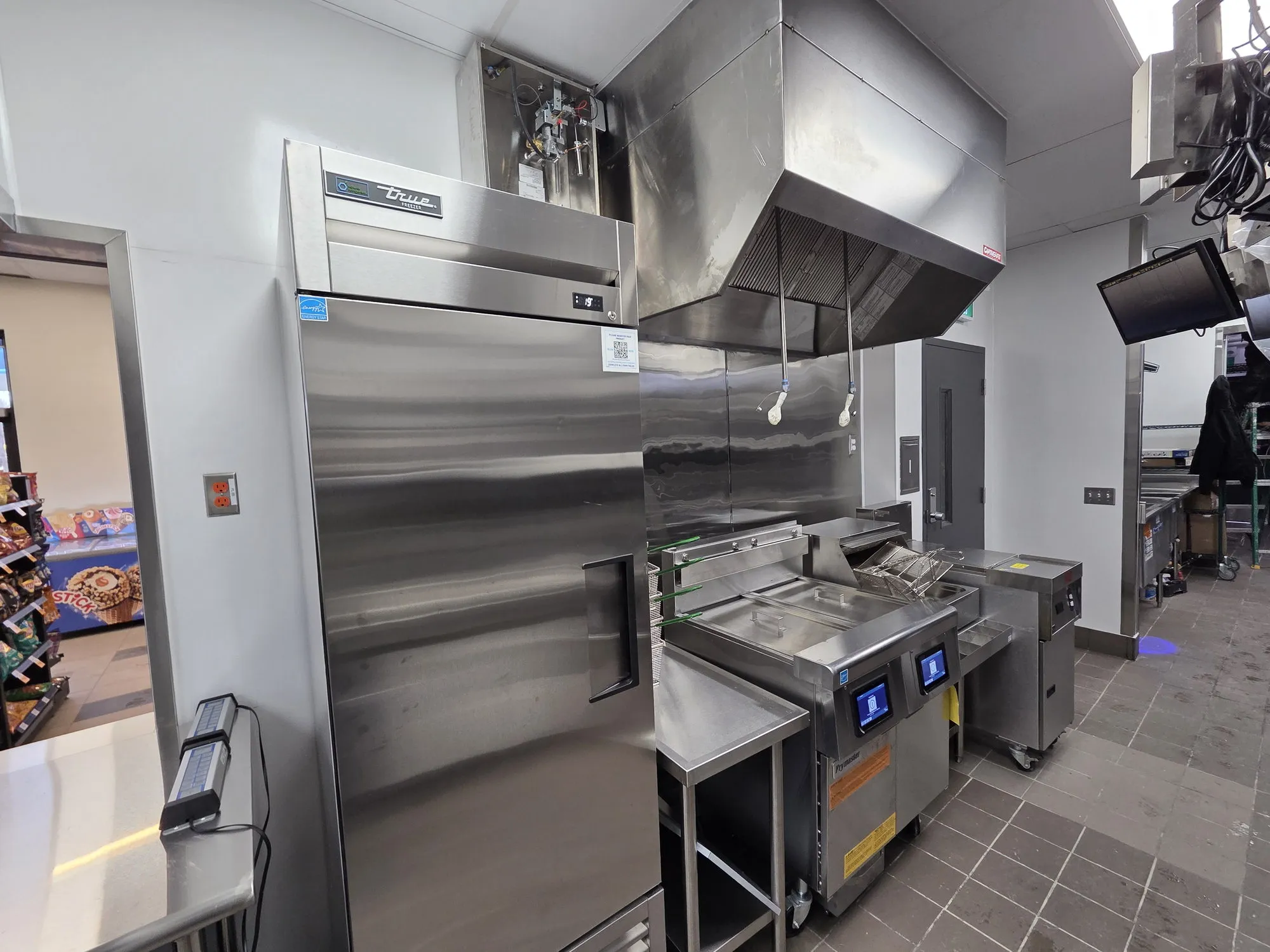
If you're cooking with grease — fryers, woks, griddles, charbroilers — you need a grease hood (Type I). For steam-only equipment like dishwashers and combi steamers, a simpler vapor hood (Type II) works. A 10-foot grease hood install in 2026 GTA dollars is industry-typically in the $25,000–$60,000 turnkey range; a 10-foot vapor hood is industry-typically $8,000–$15,000.
These are planning ranges that depend on your equipment list, ductwork routing, fire-suppression scope, fan size, make-up air capacity, and roof access — your final number comes from a line-item proposal for your specific kitchen. Picking the wrong hood type is the most expensive mistake we see on restaurant build-outs.
The two terms you'll see on drawings and inspection reports are Type I — the grease hood you need over fryers, woks, charbroilers — and Type II — the vapor or steam hood for dishwashers and steamers. From here on we'll call them the grease hood and the vapor hood. That's how the trades talk on site, and it's how you should think about your kitchen.
Important — this article is planning-stage guidance, not engineering. Final hood sizing, exhaust volume, capture, duct routing, make-up air, and fire suppression requirements must be designed by the mechanical engineer based on the actual equipment list, manufacturer specifications, site conditions, and applicable code.
In this guide: when you need a grease hood · when a vapor hood is enough · the cost spread · sizing · the checklist we use.
Want the real number for your unit?
Free site walk across Toronto & the GTA — you get a written scope and budget range within one business day.
Get a build-out estimate → or call 647-477-7999The hood decision drives more of your build-out than almost any other line. It dictates whether you need a roof penetration for welded ductwork, whether the existing fresh-air supply on the roof can be reused, how much electrical capacity the kitchen needs, and whether the fire reviewer is going to spend ten minutes on your file or two months.
If you're staring at a plaza unit, knowing your hood type before signing the work letter changes what you ask the landlord for. We see operators commit to spaces that physically can't accommodate a grease hood — no roof access, structural beam in the way of the duct route, neighbouring tenant directly above the only viable riser — and the lease is signed before anyone catches it.
Anywhere fat aerosolizes into the air, you're in grease-hood territory. There's no "a little bit of grease" exception. The list is short and the trigger is mechanical — once oil hits a hot surface, it goes airborne, and the airborne particles need a hood and ductwork built to handle them.
You need a grease hood over:
If any one of those is on your equipment list, the whole cookline sits under a grease hood — even the small piece next to the fryer that on its own wouldn't need one. You don't get to mix and match across the same hood section.
A vapor hood handles heat, steam, and odor. No grease. The classic places it lives:
A vapor hood is sheet-metal duct, mesh filters, a smaller fan, and no fire-suppression system over it. That's why it costs a fraction of a grease hood — the parts list is genuinely shorter.
For a typical 10-foot hood, industry-typical 2026 GTA install ranges look like:
Treat both as planning ranges. Final cost depends on the equipment list, ductwork routing, fire-suppression scope, fan size, make-up air capacity, and roof access — get a line-item proposal for your specific kitchen.
The 3–4x premium on the grease side isn't markup. It's that a grease hood is really five trades stitched together: sheet metal, welding, electrical for the fan and shunt trip, fire suppression with its own permit and inspection path, and the make-up air system.
Where the grease hood lands inside that range depends on how far the duct has to run to the roof, whether the existing fresh-air supply on the roof can be reused, and how much of the cooking equipment is high-BTU. We coordinate all of that under trade coordination — it's the single line item with the most cross-trade overlap on a restaurant build-out, which is why it ends up driving the schedule.
For where hood cost sits inside a full project budget, the restaurant build-out cost guide for 2026 breaks the rest of the kitchen down by line item.
Operators look at the cost spread and ask the obvious question: "My fryer is small. Can I get away with a vapor hood over it?" The answer is no, and there are two reasons your contractor will tell you to size up.
One: the building inspector flags it. The hood type goes on the mechanical drawings, the drawings go through plan review with the city, and the inspector walks the site before opening. Every step in that chain catches a vapor hood over a fryer.
You don't pass plan review, you don't pass the rough-in inspection, and the fire reviewer won't sign off on the pre-opening walk. Redesign mid-build adds 4–8 weeks and tens of thousands of dollars — a new hood, a new permit revision, sometimes a new ceiling because the welded duct routing is different from the sheet-metal one.
Two: vapor-hood ducts aren't welded for grease cooking. Vapor-hood ducts are sheet metal with seams. Run grease-laden air through that duct and over time grease seeps through the seams into the wall and ceiling cavities above. When grease finally catches fire (and it does, eventually), it spreads inside the wall before it spreads inside the duct.
That's how a kitchen fire takes the whole building. The welded grease duct, the fire-suppression system over the hood, and the access doors at every elbow exist because the trade has been burned — literally — by exactly this shortcut.
Mid-size restaurants often run both side by side: a grease section over the cookline and a vapor section over the dishpit, sometimes built into one continuous hood housing for a clean ceiling line. They share a wall but each side gets its own duct, its own fan, and its own controls. The grease side has fire suppression; the vapor side doesn't. From the floor it looks like one hood. Mechanically and on the inspector's punchlist, it's two.
This is also the right answer for kitchens that change menu over time. If you put a vapor hood over the dishpit and a grease hood over the cookline, you can move a steamer or a panini press around without re-permitting. If you put one big grease hood over everything, you're paying grease-hood operating costs (more exhaust, more make-up air, higher gas and hydro bills) on equipment that doesn't need it.
Hoods get sized in cubic feet of air per minute — cfm — pulled across each linear foot of hood. The heavier the cooking, the more air you need to capture the plume. The numbers below are industry rule-of-thumb planning numbers — final sizing by your mechanical engineer:
Two design rules sit on top of that. The hood has to overhang the cooking surface enough that the plume doesn't slip out from under and end up on the ceiling tiles — your engineer specs the exact overhang.
And every cubic foot of air leaving through the exhaust has to be replaced by the fresh-air supply that comes in through the make-up air system, conditioned to a temperature the kitchen can work in. A wok line in a 700 sf kitchen with no fresh-air supply will pull air backwards through the dining room (and the customers' hair) every time the fan runs.
Re-emphasizing the callout above: final hood sizing, exhaust volume, capture, duct routing, make-up air, and fire suppression requirements must be designed by the mechanical engineer based on the actual equipment list, manufacturer specifications, site conditions, and applicable code. The planning numbers above help you sketch the kitchen — the engineer signs the drawings.
We've gone deeper on the air-balancing piece in our commercial kitchen ventilation guide, and the hood sizing for high-output concepts is a big part of why hotpot restaurant construction costs what it does.
Q: I have a fryer and a panini press — do I need two hoods? A: One hood is fine, but it has to be a grease hood — the fryer triggers it, and the panini press just sits under the same hood. You don't get to put a vapor hood over the panini press to save money on that section. The cookline is grouped under one hood type and the heaviest piece of equipment sets the type.
Q: Can I keep the previous tenant's hood? A: Sometimes. The hood housing itself often survives if it's the right size for your cookline and the welded duct above it is intact. What usually doesn't survive: the wet-chemical fire-suppression system (it has to be recertified or replaced for the new equipment layout), the fan if it's undersized for your menu, and the make-up air unit if your exhaust cfm is higher than the previous tenant's. Industry-typical reuse-and-recertify costs land well below a fresh install, but the spread depends entirely on what's salvageable — get a line-item proposal.
Q: Does a wood-fired pizza oven need a grease hood? A: Yes. Wood-fired and gas-fired pizza ovens both melt cheese and render fat from toppings, so the duct sees grease. Wood-fired adds creosote, which is a separate fire load — many operators run a dedicated grease hood and duct just for the pizza oven for cleaning access reasons.
Q: My space already has a grease hood but the menu is steam-only now. Can I downgrade? A: You can leave the grease hood in place and just operate it — there's nothing wrong with running steam under a grease hood. You wouldn't take the welded duct down to save on cleaning costs unless the kitchen is being substantially rebuilt, in which case a fresh vapor hood is cheaper than maintaining the grease system you're not using.
Q: How much does the make-up air system add to the hood cost? A: For a 10-foot grease hood, the rooftop make-up air unit, the duct from the unit to the kitchen ceiling, and the controls that interlock it with the exhaust fan are a meaningful sub-line inside the $25,000–$60,000 grease hood install range above. If you see a quote for a "grease hood" at $15,000 for a fryer line, the make-up air piece is almost certainly missing. Get a line-item proposal so you can see each piece.
Q: Will a ductless / recirculating hood work for a small fryer? A: For a one-off small electric fryer in a non-permitted setup, sometimes. For a permitted commercial restaurant kitchen in Toronto, Mississauga, Vaughan, or anywhere else in the GTA, no — the inspectors want grease leaving the building through a welded duct, not recirculating into the dining room. Don't budget around a ductless hood for a real restaurant.
Q: How long does the hood install take inside the overall build? A: Hood fabrication is typically a few weeks from order, depending on the fabricator's queue. Install on site is a few days for the hood itself, but the welded duct and rooftop fan are coordinated with structural and roofing trades and can stretch the mechanical phase by a week or two. The fire-suppression system is installed and certified after the hood is in. Hood sizing decisions made early protect the schedule; decisions made late blow it up.
Q: Do I need a separate permit for the hood? A: The hood is part of the mechanical drawings inside the main building permit. The wet-chemical fire-suppression system has its own scope that the suppression contractor handles directly with the fire reviewer — fire suppression engineering, registration, and inspection requirements vary by scope and authority, so confirm with your mechanical engineer and the fire reviewer for your specific project. The full permit picture for a restaurant is in our Ontario restaurant permits guide.
For grease-side downstream questions — interceptors, drains, public health sign-off — see our grease trap sizing guide and the restaurant construction page for the GTA. More commonly asked questions across the build-out are answered on the main FAQ.
Send us your equipment list and a photo of the ceiling and roof, and we'll come back with a planning-stage hood spec, a rough cfm starting point, and a turnkey range you can budget against — with the mechanical engineer brought in to finalize the sizing. Call 647-477-7999 or email info@buildupcontracting.ca — or book a site walk through our contact page. Most hood decisions take 20 minutes once we see the cookline.
This article is for planning purposes only. Cost, timeline, permit, code, gas, grease trap, public health, and accessibility requirements vary by project scope, municipality, landlord, site condition, engineering, equipment list, and current trade and supplier availability. Confirm specific requirements with the municipality, architect, engineer, landlord, public health unit, fire reviewer, AGCO, registered or certified fuels contractor, electrical contractor, or other applicable authorities.
4.9 on Google
Every review from a GTA operator we built for
“BuildUp handled the full build-out of our restaurant and I honestly couldn't have asked for a smoother process. Lev understood from day one how important it was to open on schedule, and he kept everything moving — permits, inspections, the kitchen, the dining area — without me having to chase anyone.”
Kamesh Parcha · via Google
What happens when you get in touch
You deal with Lev directly. He does the site walk and writes the scope — not a salesperson who hands you off.
A written scope and a first read on budget within one business day.
Nothing is booked or billed until you say so. The site walk is free anywhere in the GTA.
WSIB clearance · $5M commercial liability · 1-year workmanship warranty · Mon–Fri 8am–6pm
Free · one business day
Three questions. We come back with a preliminary scope and a first read on budget within one business day — plus a free site walk anywhere in the GTA if it makes sense.
Prefer to talk? Call 647-477-7999. WSIB clearance and $5M commercial liability insured · 1-year workmanship warranty.
Planning a build-out
Buildup Contracting builds offices, retail stores and restaurants across the Greater Toronto Area — permits, trades and inspections on one contract, with a written scope and a first read on budget within one business day of the site walk.
Restaurant constructionRetail fit-outsOffice and commercial TIFranchise and multi-unitLandlords and property managers
Building in a specific city? These pages cover the local approvals, the departments that review them, and what usually moves the schedule there.
More of the research we use to scope real projects:
Commercial kitchen design mistakesChoosing a restaurant contractorOffice fit-out costs in TorontoBubble tea shop build-outsLease-to-opening checklistChoosing a renovation contractorAll guides
Send us the unit address, approximate square footage and your concept. We walk the space for free, then send a written scope and a real price range — no obligation.